
Mao Zedong stands as one of the most visually reproduced political figures in the 21st century. From the founding of the People’s Republic of China in 1949 through the Cultural revolution (1966 – 1976), Mao’s face saturated public and private life: monumental portraits in Tiananmen Square, mass produced propaganda posters, and the Omnipresent Little Red Book which inscribed Mao aphorisms for daily use. Mao’s authority was not sustained solely through political power or ideological doctrine but through a carefully orchestrated visual regime in which portraiture functioned as an instrument of totalitarian control. Mao was perceived not merely as a party leader but as “teacher, statesman, strategist, philosopher, poet laureate, national hero, head of family, and greatest liberator in history – Confucius plus Lao-tzu plus Rousseau plus Mark plus Buddha,”1 a synthesis of power made credible through visual repetition rather than personal encounter.
Historically portraiture has operated as a technology of authority. Whether royal, religious, or political, portraits stabilize power by presenting the subject as singular and elevated. Authority lies not in resemblance but in scarcity, ritual placement, and controlled visibility. Often so, portraits held power in distance: it is meant to be looked at, even looked up to, and encountered under conditions the reinforce hierarchy. Maoist portraiture marks a break from this tradition. Mao’s image does not individualize, it standardizes. Mao’s face is flattened and interchangeable across media, gaining authority not from uniqueness but from omnipresence. The viewer does not contemplate Mao’s image, they submit to it, a widely used tactic of communist regimes. This paper argues that the repeated reworking of Mao’s Image by Andy Warhol, Wang Guangyi, and Zhang Hongtu charts three successive stages in the transformation of portraiture in the age of mechanical reproduction, revealing that portraiture’s authority depends less on likeness or individuality than on scarcity, distance, and circulation. As Mao’s portrait moves from monumental Pop icon to rationalized ideological image and finally to a commodity, mechanical reproduction stripes it of aura and collapses the genre of portraiture itself, converting Mao, a once political subject, into a transferable sign whose power lies in circulation rather than authority.
Walter Benjamin’s essay “The Work of Art in the Age of Its Technological Reproducibility,” provides a foundational framework for understanding the transformation of Mao’s portrait. Benjamin’s central claim is not merely that reproduction alters artistic form, but that it fundamentally restructures art’s social function. For Benjamin, the authority of traditional artworks is grounded in authenticity, “the essence of all that is transmissible from its beginning, ranging from its substantive duration to its testimony to the history which it has experienced.”2 Authenticity is inseparable from aura, which Benjamin associates with distance, ritual, and unapproachability. Mechanical reproduction dismantles these conditions. Once an image can be endlessly copied and displaced from its original site, authenticity ceases to function on the basis of authority. Benjamin writes, “the instant of criterion of authenticity ceases to be applicable to artistic production, the total function of art is reversed; instead of being based on ritual, it begins to be based on politics.”3 Reproduction emancipates the artwork from its “parasitical dependence on ritual” and reorients it toward exhibition, circulation, and mass visibility. Here ritual is defined by the “sacredness” of the art and how it is displayed, that being in a church, palace, etc. For portraiture this shift from ritual to exhibit is destabilizing. The historic tendency of controlled visibility of a portrait, being place strategically and encountered within ritual frameworks is collapsed. Images “meet the beholder halfway”4 prying the object from its protective shell and destroying its aura. Benjamin emphasizes that this process does not simply weaken authority but relocates it. As reproduction increases, authority migrates from the depicted subject to the systems that circulate the image, placing power in how, where and how often a face appears.
To understand the deconstruction of Mao’s portraiture it is essential to understand the context to which Mao was displayed. Mao’s authority was inseparable from visual omnipresence. During the Cultural revolution alone, approximately 2.2 billion portraits of Mao were produced. 5 These images were not decorative artifacts; they were compulsory instruments of ideological discipline and control. Hung in homes, factories, schools and public spaces, Mao’s portrait replaced political participation with ritualized visual loyalty. Scale played a central role in simulating aura. The most famous portrait being hung in Tiananmen Square. The portrait measuring roughly six by four meters and positioned on the central axis separating the Forbidden city from the modern nation, functioned as a fix immovable sign of state power. It overwhelmed the human body, commanding submission. Mao’s gaze was described as godlike, watching over the masses and sanctioning all human activity.
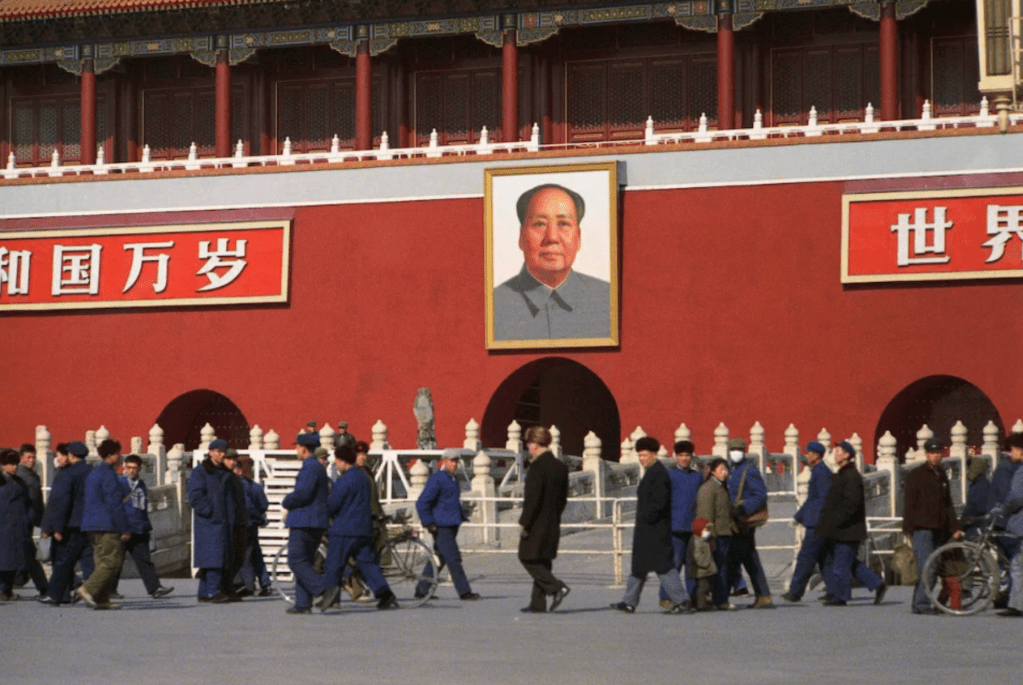
Oil on canvas; monumental architectural display.
Tiananmen Gate, Beijing, People’s Republic of China.
Image reproduced for educational and scholarly purposes.
Mao’s aura was purely manufactured as his portraiture relied on extreme standardization. Color codes were strictly enforced: Mao had to painted hong, guang, liang – red, bright and shining. Red paint was considered good and “the use of black was interpreted as a sign of an artist’s counter revolutionary intentions.”6 Mao’s face appeared smooth, radiant, and haloed, “surrounded by a divine light that illuminated the faces of the people standing in his presence.”7 The portrait functioned less as representation than as a command. This was similar in the propaganda posters produced by Mao, notably the poster termed Advance Victoriously While Following Chairman Mao’s Revolutionary Line in Literature and the Arts, 1968, depicting a disembodied Mao face hovering over the masses like a sun god. The masses below are dressed up like masses of the revolutionary model works holding the Red Book in the center. It is an image depicting the communist utopian front and promoting Maoist ideology, normally hung in homes as an “aesthetic” item. Images and posters as such were the only artistic creations allowed during the party reign and took heavy influence from Stalinist propaganda as Mao believed he was the successor to the communist party; implementing was what coined “Marxism Leninism Maoism.”8 In Banjaminian terms, Maoist portraiture weaponized mechanical reproduction. Aura was simulated through ubiquity and presence was replaced by repetition. The portrait ceased to individualize the subject and instead rendered Mao as a standardized sign.
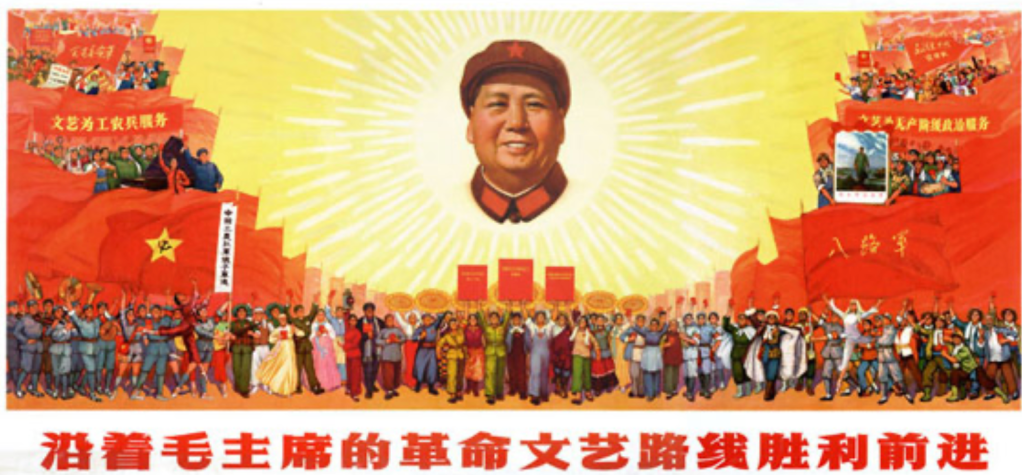
Color lithographic propaganda poster.
People’s Republic of China.
Image reproduced for educational analysis of Cultural Revolution visual culture.
Repetition operates differently in Maoist China and in Western capitalist visual culture. In Maoist China, repetition was a state technology. Wu Hung notes that during the Cultural Revolution the “chief technologies” of cultural production were “repetition and duplication,” which generated a homogeneous verbal and visual language fixed into stable, repeatable forms. Repetition functioned as infrastructure rather than style, minimizing interpretive drift and producing ideological unity.9 Benjamin notes the effectiveness of this strategy. Mechanical reproduction allows images to enter spaces “out of reach for the original,”10 embedding them into daily life and collapsing distance. In post-Mao China during the 1980’s, repetition no longer functioned as a compulsory technology of belief but became an analytical and demystifying strategy through which artists exposed the constructed nature of Maoist imagery. Chinese artists “systematically fragmented the visual language of the Cultural Revolution by extracting individual symbols from their original context and distorting them,” turning repetition into a tool of critique rather than indoctrination.11 By contrast, repetition in western Pop context operates through market saturation. Seriality is tied to mass media, advertising, and consumer saturation. As Benjamin H.D. Buchloh argues, repetition inhabits the mechanisms of circulation rather than revisiting them, revealing how images flatten generating familiarity, numbness, interchangeability, and “icon equivalence.”12 The face becomes one more endlessly repeatable surface among other repeatable surface, a political icon becomes a motif on a duvet. This distinction is crucial for understanding how Mao’s portrait fractures between the East and the West and between Mao rule and Post Mao rule. As Mao’s image circulates globally, repetition ceases to function as authority and becomes exposure, revealing its own construction.
Andy Warhol, Wang Guangyi, and Zhang Hongtu are brought together not simply because each depicts Mao Zedong, but because each artist occupies a distinct historical, geographic, and political position within the global circulation of Mao’s Image. Their difference relationships to Mao, ranging from distant observation to lived experiences, allow Mao’s portrait to be traced across three successive stages of transformation that correspond to broader shifts in visual culture, ideology, and political power.
Andy Warhol’s Mao (1972) marks the first decisive rupture in Mao’s portrait from within a Western capitalist visual economy. Warhol did not approach Mao as a revolutionary leader of ideological figure, but as an image already saturated by circulation. By the early 1970’s, Mao was widely described as “the most famous man in the world,” and in 1972 had has image on the front cover of Life magazine. This title aligned seamlessly with Warhol’s longstanding interest in figures whose identities has been flattened into public images. Warhol’s engagement with Mao coincided with President Nixon’s 1972 visit to China, a moment that abruptly introduced Mao into American mass media not as a distant enemy by as a globally legible icon.13
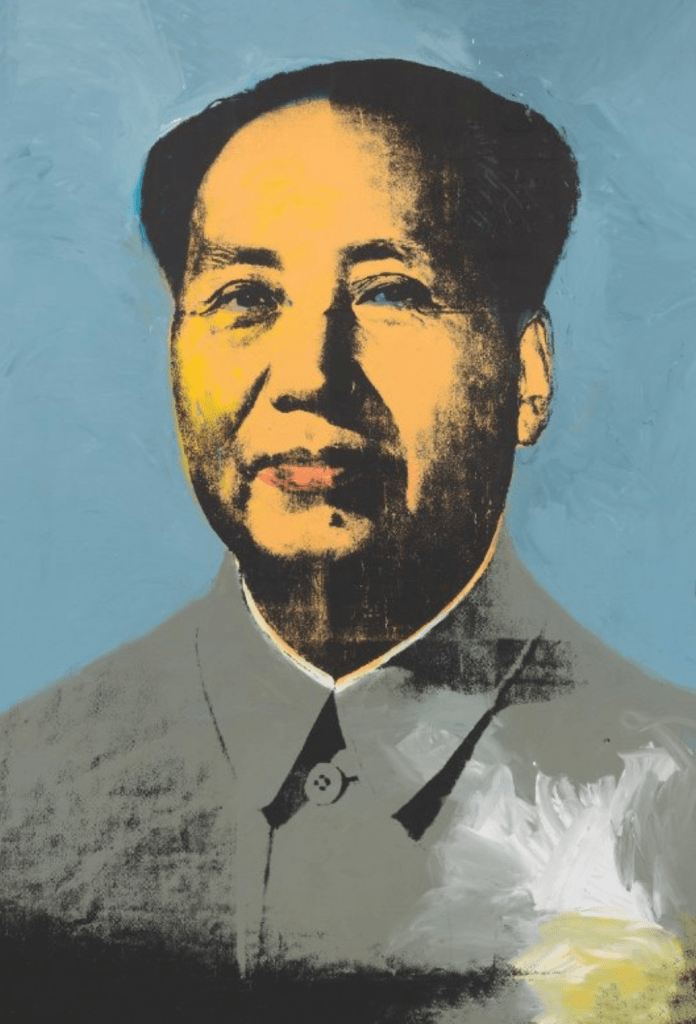
Silkscreen ink and acrylic on canvas.
Museum of Modern Art (MoMA), New York.
Image reproduced for non-commercial educational discussion of Pop Art and political iconography.
Warhol’s choice of Mao was therefore not arbitrary. His practice consistently targeted images that has already been collectively internalized and operating at a level of collective visual memory. His most noticeable portraits at this time were of Marylin Monroe and Elizabeth Taylor, depictions showcasing his acceptance of a woman’s reduction to a mass commodity fetish. Thomas Crow observes, Warhol produced his most powerful works by dramatizing “the breakdown of commodity exchange,”14 revealing how images persist once individuality has been evacuated. Mao’s portrait, already mass produced as propaganda, presented Warhol with the ultimate case: a political face whose authority depended on repetition rather than interiority. Visually, Warhol’s Mao (1972) canvas borrows the rhetoric state portraiture through scale and frontal composition. Measuring up to approximately 448 x 347 cm, the work confronts the viewers monumentally, echoing the authoritarian grammar of the official portrait in Tiananmen square. It is important to note that Warhol’s Mao is dramatically smaller than the Tiananmen Square portrait that measured 6 x 4 meters. The portrait is dominated by a limited but dissonant palette in which pale blue brush strokes surround a face washed in yellow and black, creating harsh tonal contrast that deny Mao any naturalistic warmth. Typical for Warhol was to use colors with cosmetic hues that recall advertising, cosmetics, and celebrity portraiture.15 In this way, Mao becomes legible through the same visual codes as Marilyn Monroe: public image, surface charisma, and serial reproducibility. Mao’s face is split into sharply contrasting zones of light and shadow with a flat yellow wash dominating the forehead and cheeks with dense black pigment resulting in an asymmetrical physiognomy. Upon closer look, one can spot touches of yellow paint unevenly applied to the forehead and left cheek in addition to thin brush strokes of blue in the right eye, corner of the left eye, and elsewhere on the left side of the face. The eyes appear dulled and unfocused beneath the uneven layers of paint and faintly painted petal pink mouth is covered by the black ink of the screenprint. A thick swatch of white paint pooled in the lower corner appears hastily brushed and opaque, calling attention to the surface of the canvas and interrupting any illusion of depth or finish, as if the image were partially erased or left unfinished.
The mechanically reproduced photographic image of Mao established uniformity and repetition, while the intruding and expressive paint marks expose moments where manual intervention disrupt the authority and permanence associated with the silkscreen. Warhol transfers Mao’s image which originates within one system of meaning, Maoist propaganda, to a different system governed by capitalist mass media through the process of silkscreen.16 Warhol’s artistic interventions, misregistration’s, overpainting, and surface abrasions, visualize the friction produced when an image migrates between incompatible social systems, whilst highlighting the surface and mechanical reproduction of the image.
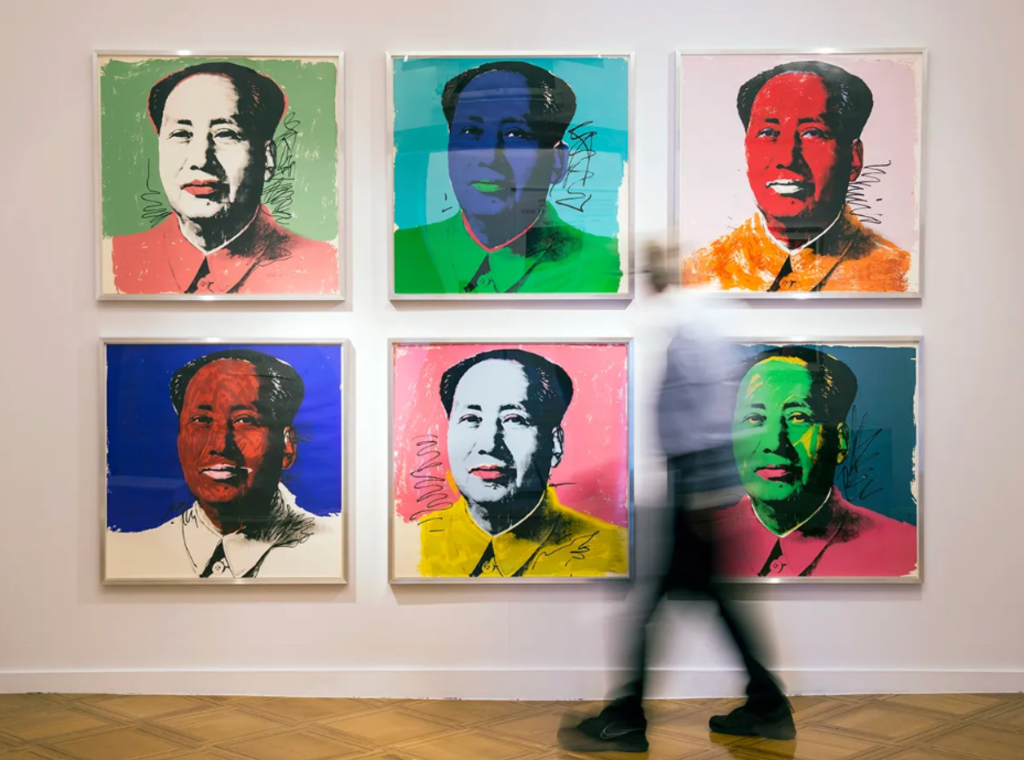
Silkscreen prints on canvas.
Various collections; installation view.
Image reproduced for educational comparison of seriality and mechanical reproduction.
Warhol’s often cited declaration “I want to be a machine”17 is not a rhetorical gesture but a methodological position. As Buchloh argues, Warhol replaces what had been considered the quintessential product of the human hand with “an impersonal autonomous mechanism that in principle could be used by anybody.”18 Warhols image of Mao is not a critique. His paintings vanish as artists’ objects to the same degree as the option to sustain dissent disappears within an organized system of immediate commercial and ideological recuperation.19 Warhol in fact, cannot stand outside ideology and even critique is absorbed by capitalism, and therefore he is showing how political power itself becomes consumable. Additionally, Wu Hung’s description of the political image as “a memorial in the sense that it resembles memory, sometimes vividly present, sometimes elusive,”20 helps to clarify Warhol’s treatment of Mao, whose silkscreened face functions less as a monument to authority than as a circulating memory image, repeatedly recalled, embellished, and drained of ideological force through mechanical reproduction. Andy Warhols Mao portrait does not resist power, it demonstrates how political authority dissolves when subjected to the logic of the culture industry. In Benjamin’s terms, Warhol accelerates the disappearance of aura. Mao’s portrait, already grounded in mechanical reproduction, is pushed one step further into capitalist circulation. Authority collapses not through opposition but through exposure. Mao vanishes as a historical individual and reemerges as a surface, a brand, an image among images. Portraiture here no longer elevates the subject; it circulates them.
The transformation of Mao’s portrait within China followed a markedly different trajectory. By the late 1970 and 1980’s, the Cultural Revolution has officially ended, and a new generation of artists began grappling with the visual legacy of Maoism. The emergence of Chinese experimental art during the ’85 New Wave coincided with ideological uncertainty, economic reform, and the gradual loosening of cultural controls.21 For the first time, Chinese artists were able to grapple with their past and turned to Western modernist and postmodernist aesthetics not as acts of imitation, but as tools for analyzing their own experience. Wu Hung emphasizes that experimental artists of the 1980s “believed in the possibility of applying modern Western aesthetics and philosophy as a means of revitalizing Chinese culture.”22 It was not a rejection of Maoist imagery, but a reconfiguration, a reinterpretation of it. Mao’s face no longer demanded belief, but it still exerted symbolic gravity. Artists sought to rationalize, fragment, and expose the visual mechanisms that once sustained Mao’s authority.23 Portraiture became a site for interrogating how images produced power.
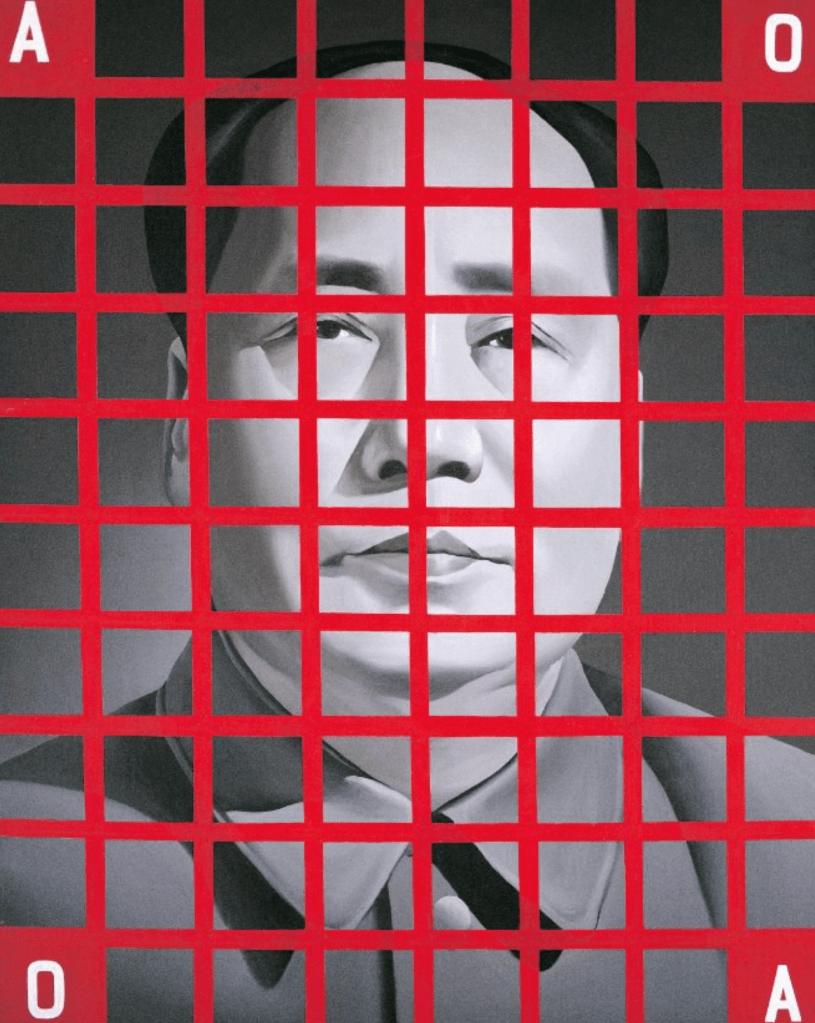
Oil on canvas.
Image reproduced for educational discussion of post-socialist realism and ideological critique.
Wang Guangyi’s Mao Zedong: Red Grid No.2 (1988) exemplifies this analytical turn. Born in 1957, wang grew up during the Cultural Revolution and experienced Mao’s deification firsthand. His paintings were produced in the late 1980, prior to the 1989 Tianamen crackdown, during a period when artists cautiously tested the limits of representation. Unlike Warhol, Wang was not external to Maoist visual culture.24 The defining feature of Red Grid No.2 is the thin red grid superimposed over Mao’s face. The grid is not decorative, it is disciplinary. Historically, grids were used during the Cultural Revolution as invisible tools for transferring Mao’s portrait onto monumental surfaces. By foregrounding the grid, wang exposes the technological scaffolding underlying Maoist portraiture. The device meant to remain unseen is visible. Visually, Mao is facing frontally starting ahead, he appears monochromatic with a cool gray tonality drained of warmth. The brushwork modeling Mao’s face is tightly controlled and smoothed with subtle, blended strokes that create sharp edges along the cheekbones, nose bridge, and jaw. The face is mask-like and emotionless, surrounded by pale white to gray tonal shading that isolated the head against a dark gray background. The red hand brushed grid dominates the composition which slice through Mao’s eyes, nose, and mouth without regard for expressive coherence. The corners of the grid are marked with a white A’s and O’s.The use of red line transforms the revolutionary red from an emotional signifier into a systemized structure. Mao is no longer encountered as a presence but as an object subjected to measurement, enclosure, and indexing. Mao’s gaze loses it power and becomes an object of study. The disciplined handling of paint, devoid of visible gesture, further emphasizes the pieces rigid geometry, so that Mao’s face appears less as a living subject than as a constructed form, locked in a system of measurement. Wu Hung describes this move as a process of “rationalization” in which Mao image is treated as a constructed artifact rather than a sacred icon.25 Portraiture here becomes a diagram, rationalizing Mao. Wang does not mock Mao, nor does he commodify him. Instead, he dissects the portraits authority by exposing its mechanism. In an interview 20 years on wang stated the grid was “a gesture of deep respect toward chairman Mao, meant to make him human.”26 At this time Mao still held high reverence in the minds of the Chinese people. By exposing Mao as human, Wang also exposes the mode of mechanical production to manufacture his aura, therefore stripping Mao from his god like status and placing him on a human pedestal. Benjamin’s theory further clarifies Wang’s rationalization of Mao. Mechanical reproduction, Benjamin argues, shifts power away from the subject toward the systems that produce and circulate the image. Wang’s grid makes this shift visible. Mao is imprisoned within an analytical frame. Portraiture ceases to mediate sovereignty and instead documents its own construction.
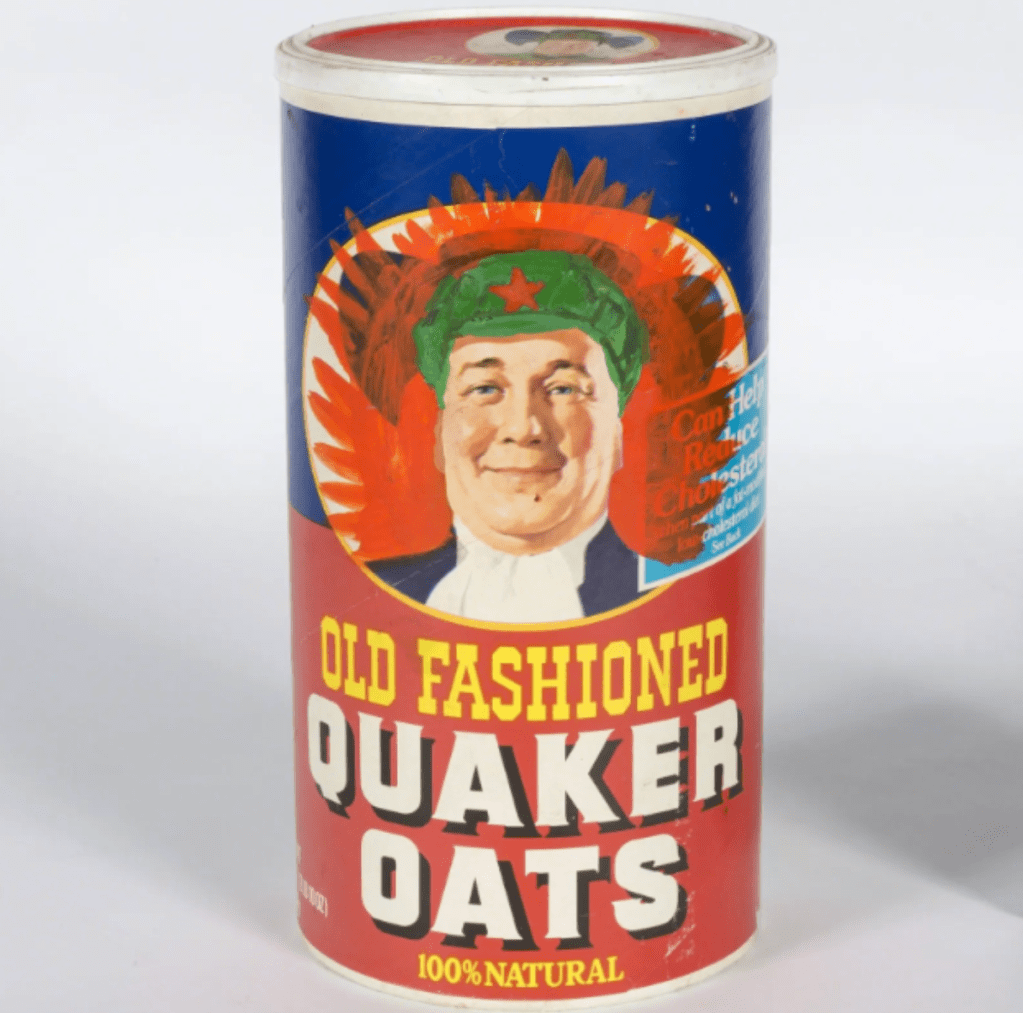
Acrylic on canvas.
Image reproduced for educational critique of cultural hybridity and political satire.
Zhang Hongtu’s Quaker Oats Mao (1987) represents the final stage in the transformation of Mao’s portrait. Born in 1943, Zhang lived through the height of Maoist rule before emigrating to the United States in 1982.27 His diasporic position allowed him approach Mao’s image with a degree of humor, irony, and emotional distance that would have been impossible within Maoist China. Zhang’s Quaker Oats Mao retains the familiar cylindrical form and commercial graphic design of a mass-produced oatmeal container with bold red, blue, and yellow branding. Mao’s face replaces the Quaker mascot within an oval frame, rendered with visible, uneven brushstrokes and warm flesh tones that contrast with the flat mechanically printed typography and logo surrounding it. This is not a portrait on canvas but a portrait on a commodity shell designed for circulation and disposal. The medium collapses the distinction between portraiture and product: Mao is no longer housed in the “serious” formats of state portraiture but in a low status substrate of consumer life as his face fits effortlessly into the logic of Western consumer packaging. The red scribbled strokes radiating behind Mao’s head are roughly applied and uneven, resembling both a halo and explosive burst. The careless execution undermines any sense of sacredness or authority. Mao’s green cap, topped with a loosely rendered painted red star, mimics the visual shorthand of communist uniforms yet appears cartoonish, with loose brushwork that strips the symbol of its ideological weight. The hat and red burst work to transform Mao’s image into a destabilized, ironic caricature embedded within consumer packaging. Zhang’s substitution does not simply mock Mao, it preforms semiotic violence against mechanisms that once held Mao’s image in place.28 The logic of the Cultural Revolution portrait was to stabilize meaning, Mao as father, sun, infallible center. Here meaning becomes transferable, Mao can sell oatmeal as he once “sold” ideology. The interchangeability is the point, Mao is a sign that can be pasted in any system. At 24.1 x 13.3 cm the work forces a mode of looking associated with shopping, close inspection, rather than civic reverence. Zhang miniaturizes and domestications Mao into something you could hold, rotate, and discard. Mao’s smirky face loses authority and transforms into something that Wu Hung defines as a “floating sign” detached from fear and ideological weight.29 Repetition no longer indoctrinates, it exposes emptiness. As Zhang himself has noted, working on Mao allowed him to pull the image “down from pantheon to reality.”30 Zhang’s turn to parody must be understand within the boarder realization among artists in the late 1980’s. As Wu Hung notes, artists increasingly recognized their “impotence in the face of real politics,”31 a condition that redirected earlier iconoclastic strategies toward sarcasm and satire. Within this context the portrait becomes playful, negotiable, and consumable, signaling not apathy but a recalibration of artistic agency under conditions of political constraint. This transformation confirms Benjamin’s theory. Once circulation replaces scarcity, aura cannot return. Portraiture collapses into commodity. Mao becomes equal among things, no longer sovereign, no longer sacred.
Mao’s image demonstrates that portraiture is never stable. It lives and dies through circulation. Once scarcity is replaced by repetition, authority collapses. In the age of mechanical reproduction, power no longer resides in the face depicted but in the systems that reproduce it. Across the works of Andy Warhol, Wang Guangyi, and Zhang Hongtu Mao’s portrait is progressively dismantled. Warhol transforms Mao into a global media icon, exposing how political authority dissolves within capitalist circulation. Wang rationalizes Mao into an ideological artifact, revealing the scaffolding beneath belief. Zhang collapses Mao into commodity form, rendering portraiture disposable and playful. Together, these artists confirm Benjamin’s insight that aura can be manufactured and dismantled. Mao is not stripped of power by erasing his face, but by revealing that his authority resided in a circulation and system rather than presence. Demystified, commodified, and emptied, Mao’s portrait reveals a fundamental truth: portraiture is not about the subject, but how the subjects are seen.
Image Use Disclaimer:
All images are reproduced under fair use for non-commercial, educational, and scholarly purposes, in accordance with U.S. copyright law. Images are used solely for the purposes of criticism, commentary, teaching, and research.
Sources:
Benjamin, Walter. “The Work of Art in the Age of Its Technological Reproducibility.” In Selected Writings, Volume 4: 1938–1940, edited by Howard Eiland and Michael W. Jennings, 251–283. Cambridge, MA: Harvard University Press, 2003.
Bastian, Heiner, ed. Andy Warhol: Mao. Munich: Schirmer/Mosel, 1976.
Buchloh, Benjamin H. D. “Allegorical Procedures: Appropriation and Montage in Contemporary Art.” Artforum 21, no. 1 (September 1982): 43–56.
Buchloh, Benjamin H. D. Andy Warhol’s One-Dimensional Art: 1956–1966. Cambridge, MA: MIT Press, 2019.
Crow, Thomas. Saturday Disasters: Trace and Reference in Early Warhol. Cambridge, MA: MIT Press, 1987.
Gao Minglu. The Wall: Reshaping Contemporary Chinese Art. Buffalo, NY: Albright-Knox Art Gallery, 2005.
Groys, Boris. The Total Art of Stalinism: Avant-Garde, Aesthetic Dictatorship, and Beyond. Princeton, NJ: Princeton University Press, 1992.
Mao Zedong. “Talks at the Yan’an Forum on Literature and Art.” In Selected Works of Mao Tse-tung, Vol. 3, 69–98. Beijing: Foreign Languages Press, 1965.
Warhol, Andy. The Philosophy of Andy Warhol (From A to B and Back Again). New York: Harcourt Brace Jovanovich, 1975.
Warhol, Andy. “Interview with Gene Swenson.” Artforum 2, no. 6 (February 1964): 26–33.
Wang Guangyi. “Statement.” In China/Avant-Garde Exhibition Catalogue. Beijing: National Art Museum of China, 1989.
Wu Hung. Art, Global Maoism and the Chinese Cultural Revolution. New York: Guggenheim Museum Publications, 2017.
Wu Hung. Shades of Mao: The Posthumous Cult of the Great Leader. Sydney: Art Gallery of New South Wales, 2003.
Wu Hung. Transience: Chinese Experimental Art at the End of the Twentieth Century. Cambridge, MA: MIT Press, 1999.
Wu Hung. Total Modernity and the Avant-Garde in Twentieth-Century Chinese Art. Cambridge, MA: MIT Press, 2011.
Wu Hung. Visual Culture in Contemporary China: Paradigms and Shifts. Durham, NC: Duke University Press, 2012.
 Art Origio
Leave a comment